

Content Marketing ROI: Measuring Success in 2025

Content Marketing ROI: Measuring Success in 2025

Measuring content marketing ROI is now a top priority for 78% of B2B marketers in 2025 – up from 65% in 2022. Why? Businesses need to prove the value of their content strategies and optimize budgets. Here’s what you need to know:

  • Key Metrics: Focus on user engagement (scroll depth, interaction rates), sales impact (multi-touch attribution), and long-term customer value (CLV).
  • Challenges: Tracking ROI is tough due to cross-channel complexity, privacy regulations, and delayed B2B attribution. Solutions include AI-driven attribution models and first-party data strategies.
  • AI Tools: Platforms like Contently, Amplitude AI, and Adobe Experience Platform are transforming ROI tracking by automating analysis, improving personalization, and predicting performance.
  • ROI Formula: ROI = (Revenue – Investment) / Investment × 100. Example: A $10,000 content investment generating $50,000 revenue delivers 400% ROI.
  • Boost ROI: Refresh content regularly, use AI for real-time updates, and prioritize high-impact formats like videos and strategic partnerships.

Core ROI Metrics for Content Marketing

User Engagement Data

When it comes to tracking user engagement, there are three key metrics you need to focus on. For 2025, the most important ones include scroll depth (how much of your content users actually consume) and interaction rates (clicks, shares, and other engagement actions).

Tools like heatmaps can help pinpoint where users drop off, while social analytics give you a clear picture of how and where your content is being shared.

Engagement Metric What It Measures Business Impact
Scroll Depth Percentage of content consumed Helps refine content structure
Interaction Rate Clicks, highlights, shares Gauges how well content resonates
Return Visitor Rate Audience loyalty Validates content strategy
Small Engagement Actions Downloads, sign-ups, etc. Signals early lead conversions

These insights play a critical role in shaping AI-driven strategies (discussed in Section 4).

Sales and Revenue Tracking

Advanced multi-touch attribution models now make it easier to understand content’s role throughout the sales pipeline. For example, Salesforce data reveals that prospects who engage with three or more pieces of content tend to close deals that are 25% larger.

Integrated tools allow businesses to track how content influences every stage of the buyer’s journey. Leads who engage with content are nearly three times more likely to convert compared to those who don’t.

Long-term Customer Value

Customer Lifetime Value (CLV) is becoming a go-to metric for connecting content engagement with long-term revenue. It’s especially useful for addressing B2B attribution challenges. For instance, SaaS customers who interact with educational content tend to have a 30% higher lifetime value.

Additionally, data shows that customers who engage with advanced content within their first month are 50% less likely to churn over the next two years. This shift toward measuring long-term impact has led businesses to prioritize post-purchase content engagement as a strong indicator of retention and upsell opportunities.

How To Measure ROI of Your Content Marketing

ROI Calculation Method

To build on the long-term value metrics from Section 2.3, calculating ROI requires a clear and structured approach. This includes accounting for both direct and indirect revenue contributions.

Total Cost Analysis

Understanding your total costs is the first step. Here’s a breakdown of typical expenses:

Cost Category Components Monthly Average*
Content Creation Writer fees, design, multimedia $5,000
Distribution Social ads, email platforms $2,000
Technology CMS, analytics tools, AI tools $1,500
Outsourcing Agency fees, freelancer platforms $3,500

*Based on SMB marketing agency benchmarks.

Use automated tools to track and categorize these expenses across departments and platforms. This ensures you have a clear picture of where your money is going.

Revenue Assignment Methods

Attribution models powered by AI can help link your content efforts to revenue. One of the most effective methods is data-driven attribution, which uses machine learning to evaluate how each touchpoint contributes to a sale.

For instance, if a $10,000 sale is made, the attribution system might distribute the revenue like this:

  • Blog post (first touch): $3,000 (30%)
  • Email campaign (nurturing): $5,000 (50%)
  • Product demo video (conversion): $2,000 (20%)

This level of detail allows you to calculate ROI for each content type and channel. Recent studies show that 68% of high-performing content marketers rely on advanced attribution models to assign revenue accurately. These models work hand-in-hand with AI tools, as discussed in Section 4.

Sample ROI Calculations

Here’s how ROI might look for different content formats:

Content Type Investment Revenue ROI Key Drivers
Technical Blog Series $5,000 $50,000 900% 50K visits ➔ 500 leads ➔ 50 conversions
Explainer Video $20,000 $100,000 400% 1M views ➔ 100K visits ➔ 200 conversions

The formula is straightforward:
ROI = (Revenue – Investment) / Investment × 100

For content with long-term value, include the Lifetime Value (LTV) of customers. For example, a $60,000 content investment that brings in 10 customers with an LTV of $5,000 each results in a long-term ROI of 733%. This ties directly to the CLV tracking methods discussed earlier in Section 2.3.

sbb-itb-8d6282e

AI Tools for ROI Tracking

Modern AI tools are transforming how businesses track ROI by automating processes and offering smarter insights. Here’s a look at how these tools are making an impact:

AI Analytics Tools

AI-powered analytics platforms are pushing the boundaries of what traditional tools can achieve. For instance, Google Analytics 5.0 now uses natural language processing to provide conversational insights.

Amplitude AI offers several key features:

Feature What It Does Business Benefit
Predicts content performance Helps prioritize resources Boosts engagement rates
Identifies content gaps Improves relevance Increases efficiency
Adjusts live campaigns Enables real-time tweaks Enhances campaign results

Emily Chen, HubSpot‘s Director of Content Marketing, reported a 37% rise in content engagement and a 22% improvement in lead quality after adopting Albert.ai in Q2 2024.

AI Content Targeting

Adobe’s Experience Platform stands out for its ability to personalize content using AI. By identifying patterns tied to high-value customer behavior, it supports strategies like those discussed in Section 2.3 on Customer Lifetime Value (CLV). Persado’s AI, for example, has achieved an average campaign performance lift of 41%.

Key features of AI content targeting include:

  • Instant audience segmentation based on engagement signals.
  • Dynamic content customization tailored to individual user profiles.

Market Analysis Tools

BrightEdge’s ContentIQ is a leader in competitive intelligence for content marketing. Using machine learning, it analyzes market trends and competitor strategies, providing actionable insights for improving content.

Crayon, another tool, tracks competitor engagement and messaging daily, offering insights that can inform budget decisions. These tools help marketers overcome attribution challenges, much like the proxy metrics discussed in Section 1.2.

Notably, 61% of marketers now consider AI a crucial part of their data strategies, according to recent studies.

Methods to Increase ROI

Building on the AI tracking tools discussed earlier, these strategies use automation to help boost returns:

Content Update Process

Regularly refreshing content can increase ROI by 67%. For instance, a B2B company saw a 35% improvement in blog ROI by using AI to identify updates and adding videos.

When updating content, focus on ways to improve engagement, such as:

  • Adding videos and infographics to make content more interactive.
  • Ensuring mobile optimization to cater to the growing number of mobile users.
  • Adjusting for voice search compatibility to align with smart assistant trends.

Budget Planning

Effective budget allocation, as outlined in earlier sections, ensures resources are directed toward impactful areas while leaving room for experimentation. Here’s a suggested breakdown:

  • AI tools and automation: 20-30%
  • Video production: 30-40%
  • Content distribution: 15-20%
  • Strategic partnerships: 10-15%
  • Performance marketing: 10-15%

AI Performance Updates

AI tools like Amplitude AI offer real-time adjustments that can significantly improve results. For example, a SaaS company achieved a 28% increase in blog post conversion rates by leveraging AI for real-time updates. These tools enhance performance by:

  1. Adjusting headlines and CTAs based on user engagement patterns.
  2. Using historical data to predict success and fine-tune content.
  3. Optimizing cross-platform distribution automatically for better reach.

Conclusion

Small Business Guidelines

Small businesses often encounter challenges when it comes to measuring content marketing ROI. However, focusing on key metrics can lead to impressive outcomes. For instance, a small e-commerce company boosted its ROI by 25% by concentrating on email and blog conversions. These strategies build upon the AI tools and customer lifetime value (CLV) methods outlined earlier in Sections 4 and 2.3.

Here are some key areas to focus on:

Focus Area Strategy
Core Metrics Monitor conversion rates, email signups, and direct sales
Content Scoring Evaluate content based on its alignment with business goals and engagement
Analytics Tools Take advantage of free tools like GA4 and social media insights

Action Steps

To put the frameworks from Sections 3-5 into action, follow these steps:

  1. Align your KPIs with your business goals.
  2. Use AI-powered analytics for deeper insights.
  3. Create a system to score content based on performance.
  4. Train your team to interpret and act on data effectively.

Start by conducting a detailed content audit. Focus on aligning content KPIs with your objectives, integrating AI tools, setting up a scoring system, and ensuring your team is equipped to handle data analysis.

Keep in mind, 42% of B2B marketers find it difficult to measure ROI consistently. You can tackle this issue by establishing clear metrics and conducting regular performance reviews. As discussed in Sections 4.1-4.3, AI-driven analytics have made advanced ROI tracking more accessible. These tools can offer predictive insights, improving ROI prediction accuracy by as much as 30%.

Related posts

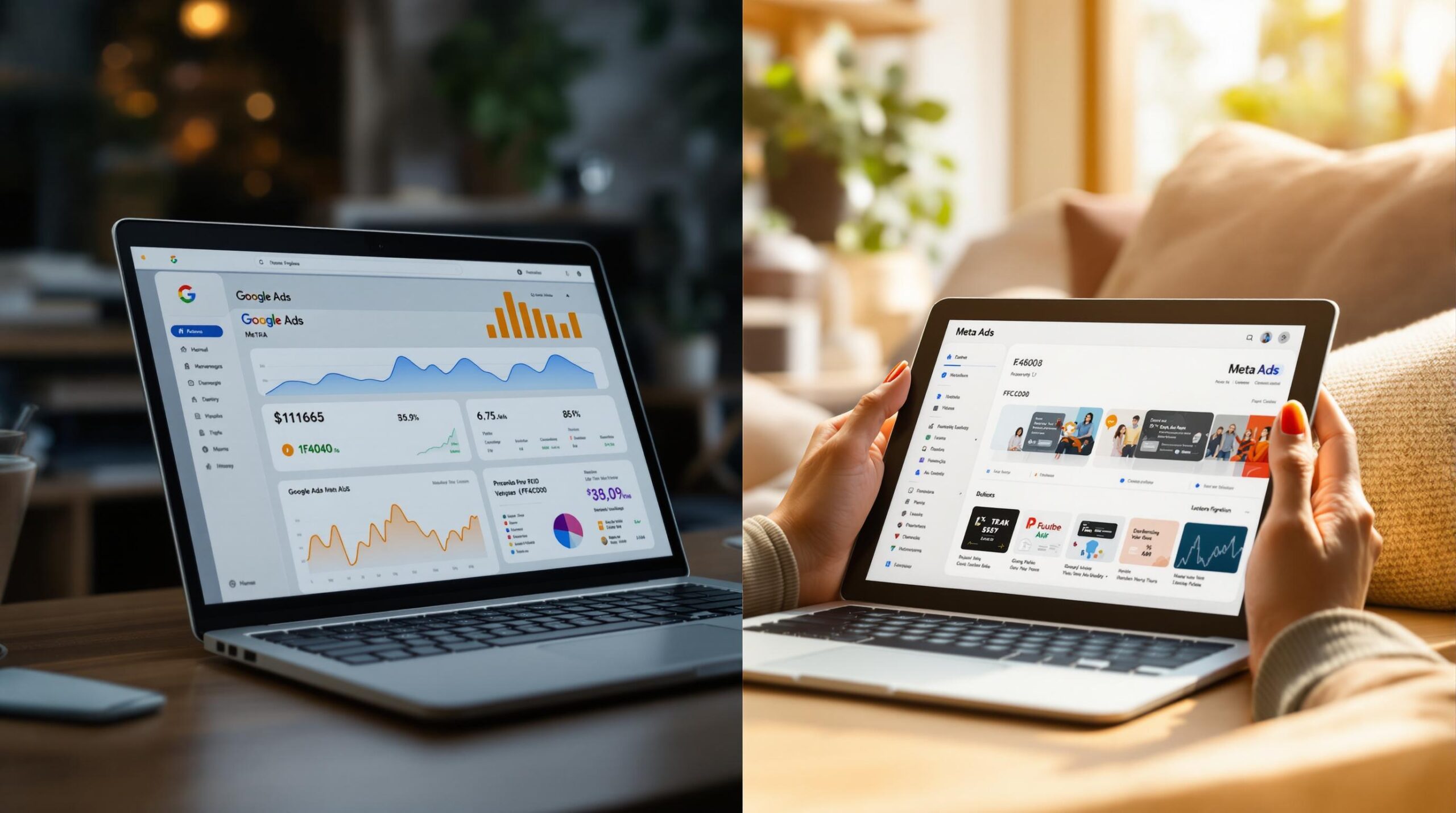
Google Ads vs Meta Ads: Better ROI?

Google Ads vs Meta Ads: Better ROI?

Which is better for your business: Google Ads or Meta Ads? Here’s the quick answer:

  • Google Ads is great for targeting users who are actively searching for products or services, making it ideal for quick conversions and high-intent audiences. It has an average conversion rate of 3.75% and a cost-per-click (CPC) of $2.69.
  • Meta Ads focuses on creating demand by targeting users based on interests and behaviors. It’s better for building brand awareness and engaging audiences, with a higher average conversion rate of 9.21% and a lower CPC of $0.97.

Quick Comparison

Aspect Google Ads Meta Ads
Primary Focus High intent (search-based) Interest-based targeting
Average CPC $2.69 $0.97
Average Conversion Rate 3.75% 9.21%
Best For Immediate conversions Brand awareness & engagement
Ad Formats Search, Display, Shopping Image, Video, Stories

Key takeaway: Use Google Ads for quick sales and high-intent searches, and Meta Ads for building awareness and engaging with broader audiences. For the best results, combine both platforms strategically.

How Each Platform Targets Users

Google Ads

Google Ads focuses on user intent by matching advertiser-selected keywords with active search queries. This method is designed to reach users who are already showing interest in specific products or services. For example, search ads boast an average click-through rate (CTR) of 3.17%.

Here are some key targeting features:

Targeting Feature Benefit ROI Impact
Keyword Intent Connects with active searchers Increases conversion likelihood
In-Market Audiences Targets users ready to buy Makes ads more relevant
Location Extensions Shows local business details Boosts local conversions
RLSA (Remarketing) Re-engages past visitors Achieves 76% higher CTR than standard ads

Meta Ads: Targeting Based on Users

Meta Ads

Meta Ads (used on Facebook, Instagram, and WhatsApp) takes a different approach by leveraging demographic and behavioral data. Instead of focusing on active intent, it targets users based on personal traits like interests, behaviors, and even data from CRM systems through Custom Audiences.

Comparing Targeting Approaches

Google Ads and Meta Ads use distinct strategies to engage audiences:

Aspect Google Ads Meta Ads
Primary Focus Active purchase intent User traits and interests
Average CPC $2.69 $0.97
Privacy Features Cookie-alternative tracking Privacy-compliant methods
Best For Quick conversions Building brand awareness and engagement

For local businesses, the benefits vary:

  • Google Ads is ideal for driving immediate actions, like purchases or bookings.
  • Meta Ads shines in fostering community engagement. In fact, 1 in 3 users on Meta platforms actively seeks local business recommendations.

These targeting differences shape how advertisers should use each platform’s ad formats, which we’ll dive into next.

Ad Types and Goals

Google Ads offers a variety of ad formats tailored to specific marketing goals. Among these, Search Ads stand out for targeting users with high purchase intent. Here’s a quick breakdown of some key formats:

Ad Format Primary Use Case Key Performance Metric
Search Ads Direct response & sales 3.17% CTR
Display Ads Building brand awareness 0.46% CTR
Shopping Ads Boosting e-commerce sales Product visibility
Performance Max Multi-channel campaigns 13% higher conversion value

Performance Max campaigns are particularly powerful for automating ads across multiple channels. For example, Wayfair saw a 20% increase in ROAS and a 10% reduction in cost per acquisition in Q2 2023 by using Performance Max campaigns.

Meta Ads Format Options

Meta’s ad formats focus heavily on visually engaging, social-first experiences. Whether you’re telling a brand story or driving product engagement, Meta provides several options:

Ad Format Best For Average Performance
Image & Video Ads Brand storytelling 0.90% CTR
Carousel Ads Showcasing multiple items Multiple product views
Stories/Reels Mobile-first engagement 10-second average watch time
Lead Form Ads Direct lead generation High form completion rates

Ad Format Performance Guide

Choosing the right ad format depends on your campaign’s goals. Here’s a guide to help match objectives with the best options on Google and Meta:

Objective Google Ads Recommendation Meta Ads Recommendation
Immediate Sales Search & Shopping Ads Collection & Dynamic Ads
Brand Awareness Display & Video Ads Stories & Reels Ads
Lead Generation Search Ads with Extensions Lead Form Ads
Local Business Local Search Ads Location-based Stories

For e-commerce, Google’s Performance Max campaigns excel by automating ad placement across channels. On the Meta side, Advantage+ shopping campaigns simplify ad creation with machine learning.

The effectiveness of these formats also ties directly to costs, which we’ll compare in the next section. While Google Search ads often come with higher CPCs due to their focus on conversion intent, Meta’s visually-driven formats are ideal for boosting brand awareness. Striking the right balance between performance and cost is key to maximizing your ad budget.

Pricing and Budget Analysis

Google Ads operates on a cost-per-click (CPC) auction system, where advertisers bid on keywords. For example, legal services typically pay $6.75 per click, while e-commerce averages just $1.16 per click.

The platform uses a Quality Score system to influence costs. Ads with a Quality Score above 8 can enjoy CPC reductions of up to 50% compared to competitors.

Industry Average CPC Average Conversion Rate
Legal Services $6.75 4.1%
E-commerce $1.16 2.9%

Meta Ads Pricing Model

Meta Ads follows a cost-per-thousand impressions (CPM) pricing model. The average CPM is $11.54, but it varies by industry – from $19.47 for finance to $6.79 for apparel.

Cost and ROI Comparison

Google Ads often justifies its higher costs by targeting audiences ready to convert. On the other hand, Meta Ads offers lower CPMs, making it effective for brand awareness campaigns.

Recommended Minimum Budgets Google Ads Meta Ads
Minimum Monthly $500-$1000 $300-$500
Daily Minimum $5 $5

Seasonal trends also play a major role. For instance, e-commerce CPCs on Google Ads can rise by up to 140% during the holiday season. Similarly, Meta Ads CPMs for retail advertisers typically spike by 50-100% in Q4. These fluctuations highlight the importance of adjusting budgets based on each platform’s strengths during peak times.

These pricing trends are key to choosing the right platform, a topic we’ll dive into next.

sbb-itb-8d6282e

Platform Selection Guide

Selecting the right platform depends on your business goals and where your customers are in their journey.

Best Uses for Google Ads

Google Ads is ideal for businesses targeting users ready to make a purchase. It shines for service-oriented businesses like legal firms and local providers, especially those addressing urgent needs, such as locksmiths or plumbers.

For B2B companies, Google Ads performs well by focusing on specific business-related keywords. These keywords align with commercial intent, often leading to higher conversion rates compared to B2C campaigns.

Industry Type Key ROI Drivers
Local Services Meeting immediate needs
B2B/SaaS High-intent keywords

Best Uses for Meta Ads

Meta Ads work best for businesses that thrive on visual content and broad audience engagement. The platform’s strength lies in its ability to drive social interaction.

Product-focused brands like fashion and home decor benefit from Meta’s image and video-friendly formats, which encourage strong audience engagement. It’s also a great choice for event promotion, with features like Stories and Reels achieving an average watch time of 10 seconds. Additionally, Meta supports community building, helping brands foster deeper relationships with their audience.

Industries with longer sales cycles, such as real estate and education, see success using Meta’s lead generation tools. These features are excellent for nurturing prospects through ongoing engagement.

Using Both Platforms Together

For the best results, use both platforms to complement each other throughout the marketing funnel.

Coordinate their strengths strategically. For example, use Google Ads to target users with high purchase intent and Meta Ads to build awareness or nurture leads. Retargeting across both platforms ensures consistent engagement with potential customers.

Funnel Stage Google Ads Meta Ads
Awareness Display ads Broad audience reach
Conversion Search ads Lead generation forms

Tracking performance across platforms is essential for understanding how each contributes to your goals. This data helps refine your strategy and optimize your budget effectively.

Conclusion

Your advertising ROI depends on matching platform strengths with the different stages of your customer journey. Based on our analysis, Google Ads excels at driving immediate conversions (with a 3.75% search conversion rate), while Meta Ads perform better for overall conversions (9.21%), thanks to its focus on social engagement. This highlights the difference between Google’s intent-driven model and Meta’s engagement-oriented strategy.

Decision-Making Checklist

When deciding which platform suits your business, focus on these key factors backed by real performance data:

Business Model Fit

  • B2B Services: Google Ads often yields better ROI through targeted, high-intent searches.
  • E-commerce: Meta’s dynamic product ads work well for showcasing visual products, while Google Shopping ads are effective for direct sales.
  • Local Services: Google’s location-based searches are ideal for generating leads.

Campaign Goals

  • Use Google Ads for:
    • Immediate sales through direct response campaigns.
    • Service-based businesses that need qualified leads.
    • High-intent purchase decisions.
  • Use Meta Ads for:
    • Building brand awareness.
    • Highlighting visual products.
    • Fostering community engagement.

Practical Considerations

  • Available budget.
  • Creative assets needed.
  • Capacity for managing campaigns.

FAQs

Is it better to advertise on Google or Meta?

The best platform for your ads depends on three main factors: how quickly you want conversions, how prepared your audience is to take action, and your campaign goals.

Google Ads is ideal for reaching customers who are ready to buy. It works well for businesses targeting people with immediate needs, like service providers. By focusing on search intent, Google Ads can connect you with prospects further down the funnel, making it a strong choice for driving quick conversions.

Meta Ads, on the other hand, is a better fit for early and mid-funnel marketing. It’s a cost-effective way to build brand awareness and engage users who aren’t quite ready to make a purchase. Plus, Meta Ads often have lower CPCs – 30-50% less than Google Ads on average.

Recent data shows that 68% of top-performing SMBs split their budget strategically, allocating 40-60% to Google Ads and 30-50% to Meta. For more tips on budget allocation, check out the Pricing and Platform Selection sections above.

Related Blog Posts

Experts in strategies for your business

Experts in strategies for your business

Unlock Your Digital Potential

Expert Strategies for Online Success

Discover cutting-edge digital marketing strategies designed to elevate your brand’s online presence and drive measurable results.

SEO Optimization

Boost your search engine rankings with our tailored SEO solutions.

Content Marketing

Engage your audience with compelling and relevant content.

Social Media Management

Enhance your brand’s visibility across social media platforms.

Latest Insights in Digital Marketing

seo services in San Marcos

Unlock The Power Of Local Seo In San Marcos With Targeted Strategies, Google My Business Optimization, And Content Tailored For Your Community.

How to make an advertisement on Google

Learn How To Effectively Set Up And Manage Google Ads Campaigns To Connect With Potential Customers And Drive Business Results.

Digital marketing companies in Dallas

Explore Top Digital Marketing Agencies In Dallas, Offering Tailored Strategies And Flexible Pricing To Boost Smbs’ Online Presence.

Google Ads Agency

Partnering with a Google Ads agency can boost your ROI and streamline campaign management for small and medium-sized businesses.

read more

Explore Our Topics

SEO Strategies

Content Creation

Social Media Tips

Email Marketing

PPC Advertising

Analytics & Reporting

Brand Development

Web Design Trends

What Our Clients Say

“Working with this agency has transformed our online presence. Their strategies are innovative and effective!”

Emily R.

“The team is incredibly knowledgeable and always goes the extra mile to ensure our campaigns succeed.”

Michael T.

“I highly recommend them for anyone looking to boost their digital marketing efforts. Truly exceptional service!”

Sophia L.

“Their expertise in SEO and social media marketing has significantly increased our website traffic.”

James K.

“Professional, creative, and results-driven. We couldn’t be happier with the partnership.”

Olivia M.

Boost Your Brand Visibility

Digital Marketing Solutions

Stay Ahead in Digital Marketing

Subscribe to our newsletter for the latest insights and strategies. Join our community of forward-thinking marketers today!

Unlock Your Business Potential

Join our newsletter to stay ahead with the latest digital marketing trends and strategies. Contact us now to transform your online presence and drive growth.