Local SEO is crucial for attracting nearby customers. 46% of Google searches are local, and 72% of those searches lead to visits within 5 miles. Here’s how to make your business stand out online:
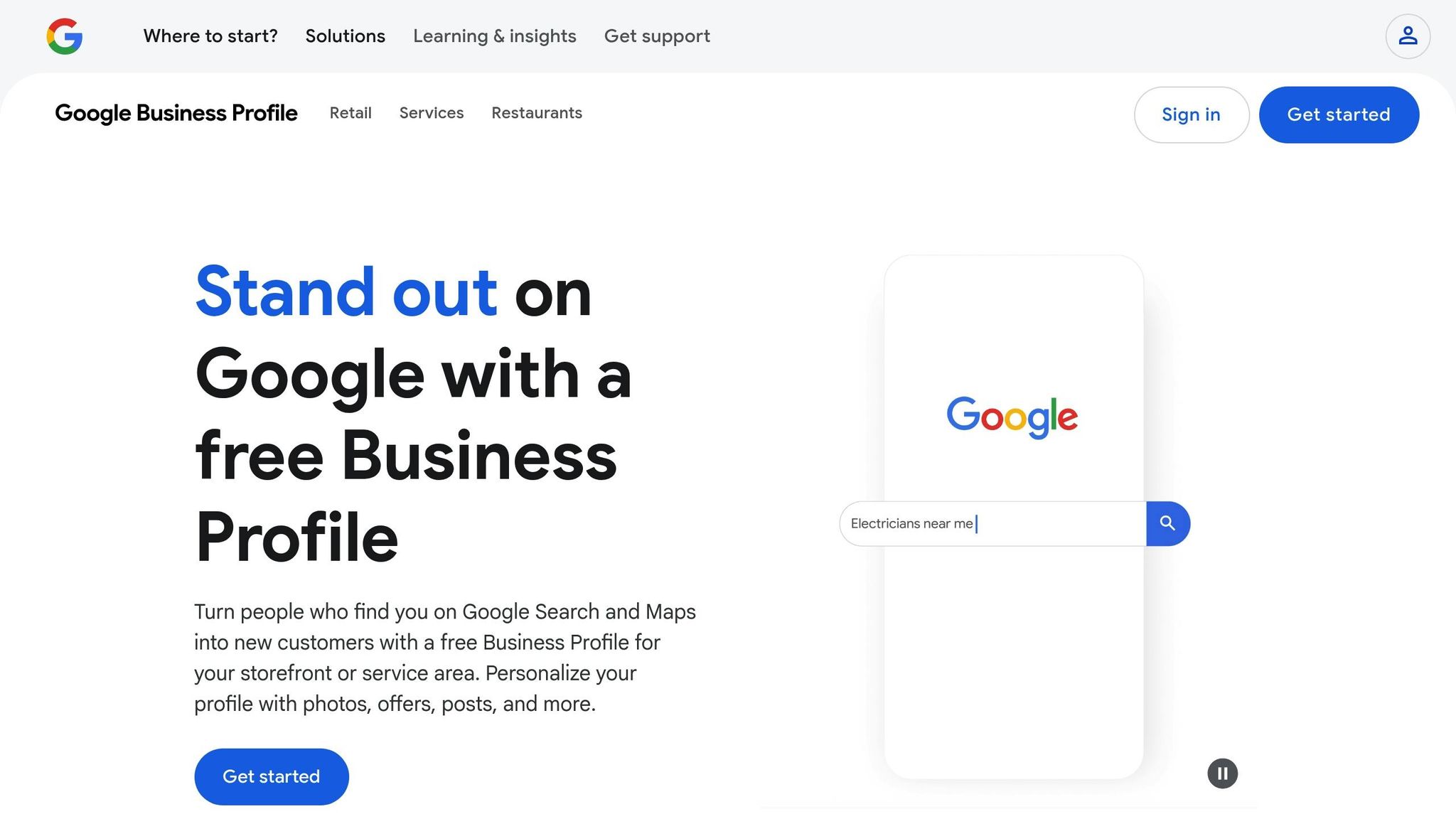
Set up and optimize yourGoogle Business Profile: Verify your business, add details like hours and photos, and keep info accurate.
Use Austin-specific keywords: Target terms like "coffee shop near South Congress" or "best BBQ in East Austin."
Your Google Business Profile (GBP) is your business’s online identity on Google Search and Maps. Setting it up correctly can make a big difference in how potential customers find and interact with your business.
Get Your Profile Verified
To get started, verify your business. Here’s how:
Search for your business on Google Maps or Search.
Select a verification method that works for you. Options include:
Video recording
Phone or text
Email
Live video call
Mail verification
Once you submit your details, Google will review them within five business days. After verification, make sure to complete your profile to improve your visibility.
Fill Out All Profile Details
A detailed profile helps attract more local customers. Make sure to include:
Your business name, address, and phone number
Website link
Service areas
Operating hours
List of products or services
A brief business description
Opening date
Special attributes (e.g., women-owned or veteran-owned)
"Businesses that add photos to their Business Profiles receive 42% more requests for directions on Google Maps and 35% more click-throughs to their websites than businesses that don’t." – Google
Upload Quality Photos
Photos can make your profile stand out. Keep these tips in mind:
Use sharp, well-lit images that highlight your business.
Update photos regularly, at least once or twice a week.
Include pictures of your storefront, interior, team, products, and even customer interactions.
Keep Business Info Consistent
Consistency is key to improving your search rankings. Here’s what to do:
Regularly monitor your profile for accuracy.
Update operating hours, especially during holidays.
Share posts about special events or promotions.
Respond quickly to messages and FAQs to maintain customer trust.
Use Austin Location Keywords
If you’re looking to boost local visibility, focusing on targeted keywords is key. Did you know that 80% of consumers search online multiple times a week to find local businesses?.
Find Local Search Terms
Start by using tools like Google Keyword Planner, SEMrush, or Ubersuggest to uncover local search terms.
Here are three types of keywords to target:
Core terms: These are your primary business offerings (e.g., coffee shop, plumber, dentist).
Modifiers: Words that describe your service, such as "best", "affordable", or "emergency."
Niche-related keywords: Phrases that reflect your specific area of expertise.
You can also use Google Trends to spot seasonal patterns or neighborhood-specific trends in Austin. Once you’ve gathered these terms, weave them naturally throughout your website.
Add Keywords to Your Website
Place your Austin-focused keywords strategically across your site. Here’s how:
Page titles: Use phrases like "Emergency Plumber in Downtown Austin."
Meta descriptions: Write unique descriptions that naturally include local terms.
Headers and content: Highlight local landmarks or area names.
Image alt text: Add location-specific context to your images.
This approach makes it easier for search engines to connect your business with local searches.
Target Specific Local Phrases
Once you’ve covered general keywords, narrow in on specific local phrases. Here are some examples:
Keyword Type
Examples
Neighborhoods
East Austin, Mueller, Westlake
Districts
The Domain, South Congress
Landmarks
Near UT Austin, By Zilker Park
Local Terms
ATX, Hill Country, Central Texas
With 32% of consumers searching daily for local businesses, it’s smart to tailor your content to match how people in Austin actually search. Use common phrases and area names that resonate locally.
For voice search optimization, include conversational phrases like:
"Where can I find…"
"Near me…"
"Best [service] in Austin…"
These adjustments can help your business stand out in local searches.
Get Listed on Local Websites
Getting your business listed on local platforms can do wonders for your visibility in Austin. These listings work hand-in-hand with the on-site SEO strategies you’ve already implemented.
Add Your Business to Directories
Make sure your business is listed on prominent Austin directories. Keeping your business information accurate and consistent across these platforms helps establish trust and improves search rankings.
Here are some key Austin directories to consider:
Austin Chamber of Commerce Directory: Being a member gives you access to a trusted directory that search engines prioritize.
AustinOne: A platform focused on businesses in the Greater Austin area.
512area.com: A detailed directory covering Austin and its surroundings.
"Business listing management is the process of making sure your company’s information is consistently and accurately represented across all digital listing platforms." – Danny Grainger, Author at Nextiva
Listing Element
Best Practice
Business Name
Use your exact legal name consistently
Address
Include suite or unit numbers if applicable
Phone Number
Opt for a local area code (e.g., 512 or 737)
Business Hours
Regularly review and update this information
Categories
Select industry-relevant tags
Once your business is listed, look for ways to collaborate with other local organizations to enhance your reach.
Work with Austin Businesses
Use your directory listings as a foundation to build partnerships with other businesses in Austin. Collaborating with local businesses can lead to mutual benefits like cross-promotion. For example, Austin Tech Hub teamed up with local tech blogs, gained valuable backlinks, and saw a 45% increase in traffic in just three months.
Join Business Groups
Joining local business organizations not only increases your visibility but also opens up networking opportunities. The Austin Chamber of Commerce is a great option – it offers a member directory and opportunities to earn quality backlinks.
To keep your listings up-to-date, consider using automated tools. These tools help you manage your business information across platforms, saving time and minimizing errors.
sbb-itb-8d6282e
Collect and Reply to Reviews
After optimizing your profile and focusing on local keywords, managing customer reviews becomes crucial for building your online reputation in Austin. Reviews play a big role in local SEO, making up 15.44% of ranking factors. A strong review profile can boost your visibility in Google’s Local Pack and Maps.
Ask Customers for Reviews
Did you know 51% of customers are likely to leave a review if asked the right way? Here’s how to approach it effectively:
Review Request Method
Customer Preference
Best Practices
Email
54%
Send the request within 24–48 hours
In-person
45%
Ask during positive interactions
Text message
29%
Include a direct link to the review page
Make the process easy by always providing direct links to your review platform.
Answer Every Review
Replying to reviews quickly shows customers you care – 97% of users read review responses, and 67% expect a prompt reply.
For negative reviews, try this approach:
Acknowledge the issue within 48 hours.
Offer a solution tailored to the problem.
Take the discussion offline if necessary.
Follow up to ensure the issue is resolved.
When issues are handled well, 95% of customers are willing to stick with the business. Use this as an opportunity to turn negative feedback into a positive experience.
Display Reviews on Your Site
With 91% of consumers reading online reviews before making a purchase, showcasing them on your website can drive decisions. Some effective placements include:
A testimonial carousel on your homepage.
A dedicated page for reviews.
Snippets on product or service pages.
Location-specific sections for reviews.
Businesses with over 200 reviews can see their revenue double.
"Reviews provide fresh content, incorporate relevant keywords, and increase user engagement, all of which are factors that search engines consider when ranking websites." – Tobias Roelen-Blasberg, Co-Founder & Head of Product, MARA
Keeping reviews fresh and consistent signals to Google that your business is active and relevant in Austin. Automating review requests can help maintain this flow, but always ensure you follow platform rules.
Write About Austin Topics
Creating content that connects with Austin’s local vibe can improve search rankings and strengthen community relationships. Let’s look at how you can use local news, area-specific content, and community involvement to make a bigger impact in Austin.
Cover Local News
Writing about local news helps build trust and credibility. Focus on topics that align with your industry and Austin’s unique interests:
Content Type
SEO Benefits
Example Topics
Industry Updates
Boosts relevance
Local business developments
Event Coverage
Signals location
Festivals, markets, conferences
Community News
Builds authority
Neighborhood developments
Business Spotlights
Encourages backlinks
Local success stories
When covering local news, include specific Austin landmarks to show geographic relevance. Mention places like “South Congress Avenue” or “The Domain” instead of using vague terms.
Create Area-Specific Pages
Set up separate pages for each Austin neighborhood you serve. Tailor the content to reflect the unique characteristics of each area:
North Austin: Talk about the tech corridor and suburban family life.
South Austin: Highlight the artistic communities and local food scene.
East Austin: Focus on cultural heritage and new businesses.
Downtown: Cater to urban professionals and entertainment options.
"Getting involved in your community isn’t just good business, it’s great for SEO." – Sarah, Director of SEO, Wit Digital
Understand what people in each area are searching for and write content that addresses their specific needs. Avoid using one-size-fits-all copy across different location pages.
Show Local Involvement
Being active in the Austin community not only strengthens your local presence but also boosts your SEO efforts:
Event Sponsorships: Share stories about events you’ve sponsored or attended. These can lead to backlinks from event websites and local news outlets.
Community Partnerships: Highlight collaborations with other Austin businesses or organizations. These partnerships often result in cross-promotion and improved local visibility.
Local Impact Stories: Showcase how your business contributes to the community. Whether it’s supporting local charities or taking part in neighborhood projects, these efforts build trust with your audience.
Make Your Site Mobile-Ready
More than half of Austin searches happen on mobile devices. It’s time to ensure your site is optimized for these users.
Build for Phone Users
Google now prioritizes mobile-friendly sites when determining rankings. To stay competitive, focus on these essentials:
Mobile Feature
SEO Impact
Tips for Implementation
Responsive Design
Boosts rankings
Adjust layouts for all screen sizes
Touch Elements
Lowers bounce rates
Use buttons that are at least 44px
Click-to-Call
Increases conversions
Add tap-to-dial functionality
Navigation
Enhances user experience
Use easy-to-access hamburger menus
Here’s a critical stat: 50% of Austin consumers who find a business on mobile visit it within 24 hours. But a sleek design isn’t enough – your site also needs to load fast.
Speed Up Your Website
Site speed plays a big role in both user experience and search rankings. Did you know that 53% of users leave a site if it takes longer than three seconds to load? Here’s how to speed things up:
Optimize Images: Use tools like TinyPNG or ImageOptim to compress images. Switch to formats like WebP for smaller file sizes without losing quality.
Streamline Code: Remove unnecessary code, combine CSS/JavaScript files, and enable Gzip compression to shrink file sizes.
Use Local Servers: Choose a hosting provider with servers near your audience – like in Texas – to reduce loading times. Adding a Content Delivery Network (CDN) can also improve speed.
"Mobile page speed is not a one-time fix. Periodically monitor your website’s performance to identify potential bottlenecks and areas for improvement." – Lora Raykova, User Experience Content Strategist
A fast-loading site not only improves rankings but also helps you prepare for the growing trend of voice search.
Prepare for Voice Search
Voice search is becoming a major driver of local SEO, with 39% of users relying on it to find business information. Here’s how to cater to voice searchers in Austin:
Voice Search Element
Local Strategy
Example
Natural Language
Use conversational phrasing
"Where’s the best BBQ in South Austin?"
Local Keywords
Include neighborhood names
"coffee shop near Downtown Austin"
Question Format
Answer common queries
"What time does [your business] open?"
Add a simple FAQ section using conversational language, and reference Austin landmarks or neighborhoods to boost your local relevance.
Keep in mind, mobile voice searches are three times more likely to focus on local topics. These mobile optimizations are key to connecting with Austin’s on-the-go audience.
Connect on Social Media
Once your website is mobile-friendly, take your efforts further by connecting with Austin’s online communities. Social media is a powerful tool to engage with local audiences and improve your visibility.
Join Austin Online Groups
Getting involved in local online communities can help you stand out. Focus on platforms where your audience is already active, such as:
Facebook: "Austin Small Business Network"
Reddit: r/Austin, r/AustinLocal
LinkedIn: "Austin Business Leaders"
NextDoor: Neighborhood-specific groups
When engaging in these groups, focus on being helpful rather than promotional. Share your knowledge, answer questions, and interact naturally with others. This type of participation builds trust and sets the foundation for effective hashtag use to expand your reach even further.
Use Austin Tags
Using hashtags and geotags together can make your content easier to find locally. Try incorporating:
Community Tags: #AustinTX, #ATX, or niche ones like #AustinEats
Neighborhood Tags: #SoCoATX, #EastAustin
Don’t forget to geotag your posts when showcasing your business location or participating in local events.
Post Local Updates
Sharing updates relevant to Austin can boost your SEO and connect you with the community. Dapper Market Solutions LLC recommends creating timely, location-focused content that resonates with your audience.
Here are some ideas to align your posts with Austin’s vibe:
Event Coverage: Highlight upcoming festivals, markets, or community events.
Local Partnerships: Showcase collaborations with other businesses or community involvement to build trust.
Behind-the-Scenes: Share how your team participates in or celebrates Austin’s culture.
"Engaging with customers through comments and messages on social media significantly enhances a business’s local presence and fosters relationships within the community." – Dapper Market Solutions LLC
Keep an eye on social media analytics to see what content resonates most with your audience, and adjust your strategy to improve engagement.
Conclusion
Local SEO is a powerful driver for small business growth in Austin. Did you know that 46% of Google searches are local, and 72% of those searchers visit a nearby store? By refining your Google Business Profile and staying active on social media, you can significantly improve your local visibility.
Take "Joe’s Diner" as an example. After adding local schema markup, they saw a 28% jump in click-through rates and a 15% increase in calls within three months. This shows just how impactful these strategies can be.
"SEO levels the playing field by improving your website’s search ranking, enabling you to compete with bigger companies on equal footing, even with a modest budget." – Nate Elliott, VP at BizIQ
Strategy
Impact
Google Business Profile updates
30% more calls
Proactive review management
40% increase in Google reviews
Mobile-friendly website design
25% boost in online reservations
Local content creation
30% rise in website visits
Chris Coussons, Founder of Visionary Marketing, emphasizes the importance of reviews:
"Reviews aren’t just for reputation; they play a direct role in rankings and conversions. A steady stream of high-quality, recent reviews shows Google (and potential customers) that the business is active, trusted, and relevant."
To stay ahead, use tools like SEOptimer or BrightLocal to track your local rankings and analyze your Google Business Profile insights. With 78% of local mobile searches leading to purchases, these efforts can directly increase your revenue. Start optimizing now to turn those local searches into loyal customers.
Struggling to get high-quality B2B leads? Here’s a quick guide to help you improve lead generation, boost conversions, and align marketing with sales. Start with these key steps:
Understand Your Audience
Build detailed customer profiles.
Identify decision-maker roles in the buying process.
Research company data like size, tools, and growth indicators.
Optimize Your Website
Use simple, mobile-friendly forms with 5–7 fields.
Create focused landing pages with fast load times and clear CTAs.
Offer premium content like reports, guides, or webinars in exchange for contact details.
Leverage LinkedIn
Polish your LinkedIn profile with a professional photo and clear value statement.
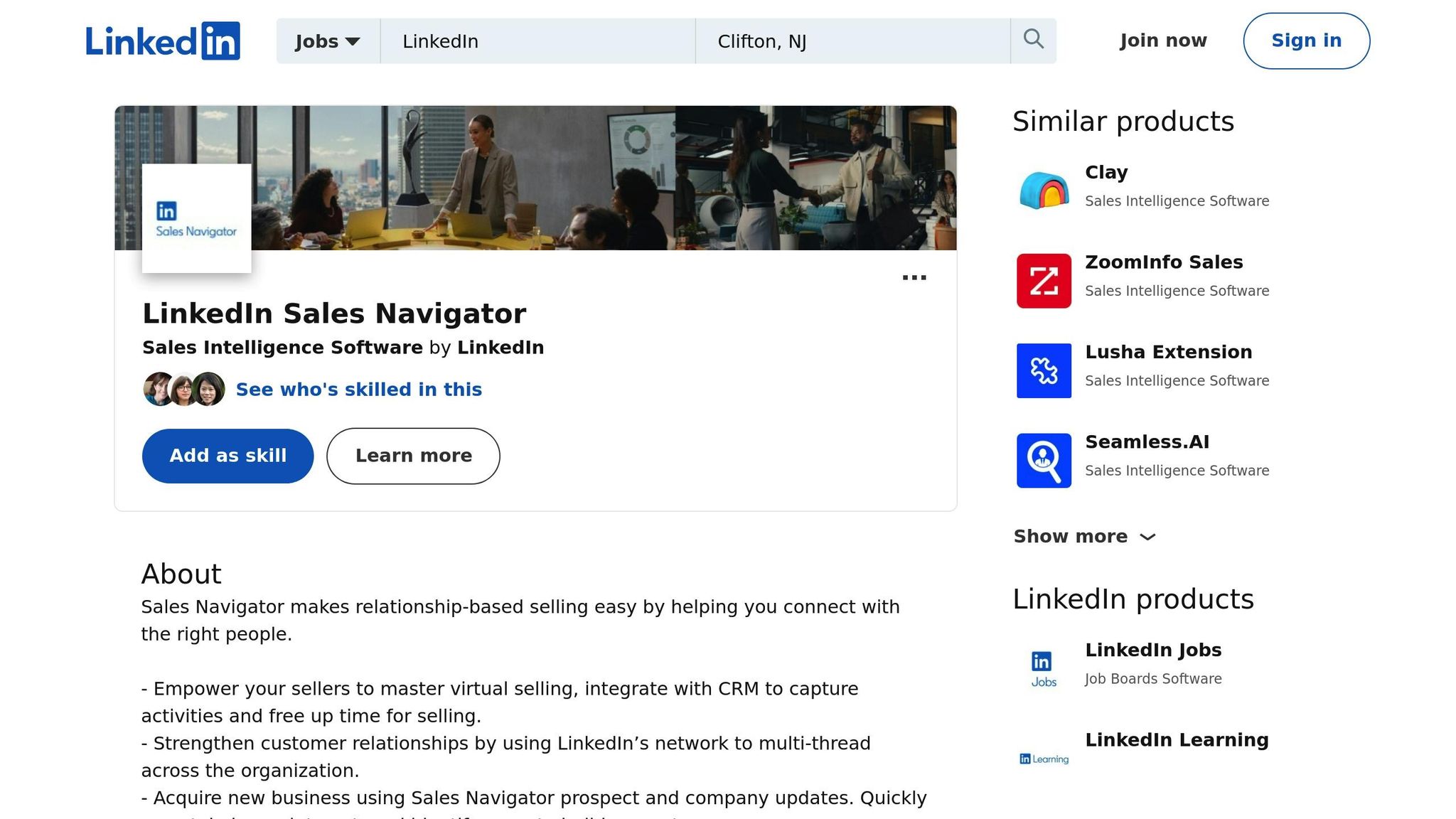
Use Sales Navigator to target decision-makers and monitor activity.
Post industry news, company updates, and videos regularly.
Run Email Campaigns
Segment email lists by industry, role, and behavior.
Monitor key metrics like conversion rates and lead quality.
Apply insights to refine strategies and improve ROI.
Consider Marketing Agencies
Agencies can provide cost-effective lead generation services.
Look for expertise in Google Ads, SEO, and CRM integration.
Choose flexible pricing models like monthly retainers or cost-per-lead.
B2B Marketing Strategy: How To Get More Leads For B2B Businesses
Build Your Customer Profile
Creating detailed customer profiles is a game-changer for B2B lead conversion. Companies with well-documented personas are 71% more likely to surpass revenue and lead targets. These profiles are the backbone of personalized outreach and improved conversion rates.
Create Customer Personas
To build effective customer personas, rely on data from multiple sources:
Data Source
Insights to Collect
Sales Teams
Common objections, decision timelines, pain points
Customer Success
Feedback after purchase, implementation challenges
Internal Database
Buying patterns, trends by company size
Executive Team
Industry expertise, strategic focus
Customer Surveys
Priorities, challenges, and direct feedback
Research-backed personas have been shown to deliver 73% higher conversion rates from initial responses to marketing qualified leads (MQLs).
Key traits to define in your personas include:
Their role in the purchasing process
Organizational challenges and objectives
Technical needs and limitations
Budget authority and approval cycles
Pain points specific to their industry
These details help you zero in on the decision-makers who matter most.
Map Decision-Maker Roles
B2B sales often involve multiple stakeholders. Knowing who plays what role is critical.
"The SDRs use the platform daily, whereas the Sales Executives are more ad-hoc. They predominantly use the database for multithreading by finding contact details of decision-makers within existing accounts." – George Elsey, Sales Operations Analyst, Slalom
Here’s how to map decision-maker roles:
Analyze communication patterns from successful deals.
Identify key players such as champions, end-users, and technical evaluators.
Monitor job changes for opportunities with new executives.
Use intent data to spot who’s actively researching solutions.
Develop tailored content for each stakeholder type.
Research Company Data
Take advantage of research tools to gather critical business details:
Attribute
Focus Areas
Company Size
Employee count, revenue brackets
Technology Stack
Current tools, integration requirements
Growth Indicators
Recent funding, hiring trends
Industry Position
Market share, key competitors
Geographic Presence
Office locations, operational regions
"Our sales cycle is typically 6-8 months long. At Cognism, we saw ROI in 8 weeks from intent data and direct dials. One deal pays for a year’s Cognism subscription." – Alexander Porter, Senior Business Development & Inside Sales Lead, Devo
Tools like LinkedIn Sales Navigator or Cognism can provide verified company data. Combining accurate company insights with your personas and decision-maker maps ensures you’re targeting the right leads effectively.
Set Up Website Lead Capture
Turning visitors into qualified leads means using well-placed forms and targeted content effectively. A solid website lead capture system plays a key role in supporting your customer profiling and outreach efforts.
Build Effective Forms
The design and functionality of your forms can make or break your conversion rates. Here are some key tips to keep in mind:
Form Element
Best Practice
Impact
Field Count
Keep it to 5–7 fields
Reduces drop-offs
Mobile Design
Use larger buttons and vertical layouts
Increases completion rates
Auto-fill
Enable browser auto-complete
Saves user time
Accessibility
Ensure high contrast and readable fonts
Improves usability
Privacy
Add a clear data usage statement
Builds trust
"To optimise B2B landing pages, make sure your calls-to-action are short and direct. Leave no room for misinterpretation." – Waseem Bashir, CEO of Apexure
Once your forms are ready, the next step is creating landing pages that keep visitors engaged and motivated.
Design Landing Pages
Landing pages should have a simple layout and clearly communicate your value. Here’s how to get started:
Page Structure Eliminate navigation menus to keep visitors focused on the form. Speed matters – 40% of users will leave a mobile site if it takes more than 3 seconds to load. Use techniques like image compression and browser caching to improve load times.
Content Layout Highlight the main benefits above the fold using bullet points. A/B testing can increase conversions by up to 40%.
"Moving B2B prospects from one stage to the next takes more than just a fancy website. You need focused, specific pages that speak directly to where your visitors are in their buying journey." – Unbounce
After optimizing your landing pages, take it a step further by offering high-value content that aligns with your audience’s needs.
Create Premium Content
Premium content encourages submissions by providing something valuable in exchange for contact details. In fact, 74% of B2B marketers say content is their most effective tool.
Content Type
Best Use Case
Conversion Impact
Research Reports
Share original data and insights
High perceived value
Executive Guides
Help with strategic decisions
Appeals to C-suite
Case Studies
Show real-world outcomes
Builds credibility
Webinars
Provide interactive learning
Drives real-time engagement
"Most people will miss most of the emails in the sequence, or only one email actually piques their interest that day to engage and click. Therefore, every email should be a delivery mechanism for an always-on resource that can be consumed by the reader whenever it suits them. You want to give your audience the freedom to decide which content they consume." – Alice de Courcy, CMO at Cognism
Use LinkedIn for Lead Generation
LinkedIn is a powerhouse for B2B marketers, with 89% using it for lead generation and achieving a lead conversion rate that’s 277% higher than Facebook and Twitter/X. To make the most of it, focus on refining your LinkedIn strategy to improve lead quality.
Set Up LinkedIn Profiles
Think of your LinkedIn profile as your digital business card – it’s often the first thing potential leads will see. Here’s how to make it stand out:
Profile Element
Best Practice
Purpose
Profile Photo
Use a clear, professional headshot
Builds trust and recognition
Headline
Include your job title and a value proposition
Boosts searchability
Summary
Highlight measurable achievements
Shows expertise
Experience
Add keyword-focused descriptions
Improves visibility
Media
Share company videos and presentations
Highlights your company culture
"Once trust has been lost, it’s nearly impossible for brands to rebuild sustainable, honest relationships with their customers." – Kevin Cochrane, former chief marketing officer, SAP
Once your profile is polished, use LinkedIn Sales Navigator for targeted outreach.
Sales Navigator is a game-changer for finding and connecting with decision-makers. Use its tools effectively with these tips:
Feature
How to Use It
Why It Matters
Advanced Search
Use Boolean operators for precise filtering
Find the right prospects
Account Maps
Visualize your network connections
Identify key decision-makers
Lead Monitoring
Track prospect activity
Reach out at the right time
Custom Lists
Group prospects into specific categories
Simplify follow-ups
Take Laura Heffron from Extended Stay America, for example. She used Sales Navigator to organize leads by role and location, positioning herself as a trusted advisor in temporary lodging.
"LinkedIn provides a trusted forum." – Laura Heffron, Regional Account Director at Extended Stay America
Combine these tools with a strong, consistent LinkedIn presence for even better results.
Build LinkedIn Presence
Posting engaging content regularly is crucial. In fact, LinkedIn pages that post weekly see twice the engagement. Here’s a simple content strategy to follow:
Content Type
Suggested Frequency
Why It Works
Industry News
3x weekly
Builds authority
Company Updates
2x weekly
Highlights company culture
Product Info
1x weekly
Encourages conversions
Video Content
2x monthly
Drives 5x more engagement
Try the 3-2-1 formula: share three pieces of industry-related content, two that showcase your company culture, and one promoting your solutions.
Greenhouse Software nails this approach. Their LinkedIn profile clearly communicates their value while maintaining steady engagement with their audience.
sbb-itb-8d6282e
Run Email Marketing
Email marketing offers a massive return, delivering $42 for every $1 spent. It’s also the top choice for 79% of B2B marketers when it comes to generating demand. This channel plays a key role in guiding leads through the sales funnel, from awareness to conversion.
Organize Email Lists
The foundation of effective email marketing is a well-organized list. Segmentation is key – businesses using segmented campaigns have reported revenue boosts of up to 760%. Here’s a quick breakdown of how to segment your lists:
Segment Type
Criteria
Benefits
Industry
Company sector, size
Tailored solutions by vertical
Role
Decision-maker level
Specific messaging by authority
Behavior
Website activity, downloads
Engagement-based follow-ups
Journey Stage
Prospect to customer
Content aligned with their stage
For example, Sender, an email marketing platform, saw a 30% jump in open rates and a 50% increase in click-through rates after adopting segmentation. Once your lists are sorted, the next step is creating email sequences that resonate with each group.
Write Email Sequences
Email sequences are about creating value and building trust. Personalized messages can drive 6x higher transaction rates compared to generic ones. Below are some common types of sequences and their goals:
Sequence Type
Purpose
Key Elements
Welcome
First impressions
Company intro, value proposition
Nurture
Build trust
Insights, case studies
Decision
Encourage conversion
Product benefits, social proof
The goal here is to nurture relationships before pushing for a sale. Once you’ve mapped out your sequences, use automation to deliver them at the right time.
Set Up Email Automation
Automation takes your email marketing to the next level, allowing you to scale efforts while staying relevant. Lead nurturing automation can generate 50% more sales-ready leads while cutting costs by 33%. Here are some automation triggers to consider:
Automation Trigger
Action
Expected Outcome
Form Submission
Send welcome sequence
2.5x higher click-through rates
Content Download
Deliver related resources
5.7% revenue increase
Website Activity
Send targeted offers
Triple conversion rates
"Lead nurturing is like gardening… It’s about time, relevance, and a favorable environment to expect the growth from the seeds you have sown." – Banish Angural, founder of Banish Media
To get the best results, aim for email deliverability rates of 85%-95% and open rates between 17%-28%. Keep an eye on these metrics to continuously improve your campaigns.
Track and Improve Results
Keep a close eye on your lead generation efforts and make adjustments to improve both conversion rates and revenue. Research shows that while 79% of marketers prioritize lead generation as a goal, 80% admit their efforts are only somewhat effective. This highlights the importance of tracking performance and refining your approach over time.
Install Tracking Tools
To get a clear picture of your lead generation performance, consider using these tools:
While Google Analytics is excellent for understanding website traffic, it doesn’t track individual lead journeys effectively. Tools like Ruler Analytics can fill this gap by linking multiple touchpoints to revenue. Combining these tools ensures you have a more complete view of your lead generation efforts.
Monitor Key Metrics
Tracking the right metrics can significantly improve your results, with conversion rates potentially exceeding 50% and ROI increasing by 10–30 times. Focus on metrics that reveal lead quality, response times, and the revenue impact of your efforts.
"When lead generation is the goal, the metrics need to tell you about the number, purchasing intent, and revenue-generating potential of the prospects entering your sales funnel." – Trendemon
These insights will help you identify areas to improve and fine-tune your strategies.
Apply Data Insights
Poor lead qualification accounts for 67% of lost sales. Use your data to continuously refine your approach:
Run A/B tests on landing pages and emails.
Use lead scoring to qualify prospects more accurately.
Apply multi-touch attribution to identify your most effective channels.
Leverage predictive analytics to target the right audience.
For example, Cognism uses a rapid response system to contact inbound leads within three minutes, achieving a 70% success rate in early interactions. Since half of qualified leads aren’t ready to buy immediately, it’s equally important to develop nurturing strategies that guide them through the purchasing process.
Work with Marketing Agencies
Many B2B companies team up with marketing agencies to boost lead generation efforts. The lead generation market is expected to hit $9.5 billion by 2028, with outsourced solutions delivering 43% better results than in-house efforts.
CS Digitall offers a mix of services, including Google Ads, Meta Ads, SEO, and CRM solutions. These tools are especially useful for B2B buying cycles that often stretch beyond four months.
Service Category
Key Features
Best For
Google Ads
Keyword-focused campaigns, intent-based targeting
Capturing early-stage leads
Meta Ads
Custom audience targeting, retargeting
Building brand awareness and nurturing leads
SEO
Technical improvements, content strategies
Generating leads over time
CRM Integration
Lead tracking, automation
Streamlining the sales process
"Google Ads give advertisers very targeted control on the types of users they bring in, since it’s keyword-based. We can hone in on very relevant keywords that specifically speak to things users are actively seeking, leading to lower acquisition costs." – Sam Yadegar, HawkSEM CEO
Beyond individual services, working with agencies provides additional strategic benefits.
Why Partner with an Agency?
Specialized marketing agencies can enhance your lead generation efforts in three key ways:
Cost-Effective Solutions
Agencies often deliver leads at a lower average cost: $53 per B2B lead.
Flexible pricing models to suit different business needs:
Pricing Model
Starting Range
Best For
Monthly Retainer
$8,000+
Businesses needing steady lead flow
Cost Per Lead
$150-250
Performance-focused campaigns
Hourly Rate
$25-50
Short-term or project-specific tasks
Specialized Expertise
Agencies bring advanced tools and proven techniques to the table.
For example, Brandcave used Leadfeeder’s filtering to generate 200 qualified contacts in just one day (Dealfront, 2024).
They also offer industry-specific insights and strategies.
Scalable Operations
Agencies can quickly adjust strategies based on performance data.
They provide flexible resources to match your business needs.
This approach is favored by 66% of U.S. companies aiming to stay competitive.
When choosing an agency, look for proven results, clear communication, and case studies that back up their claims. While upfront costs may seem higher than in-house options, the long-term benefits and improved focus on core operations often make the investment worthwhile.
Checklist Summary
Generating B2B leads effectively demands a structured approach that emphasizes quality over sheer numbers. Here are some key areas to focus on:
Focus Area
Key Actions
Impact Metrics
Lead Quality
Set up a qualification process
Helps tackle the 67% of lost sales caused by poor lead qualification
Content Strategy
Create and share tailored content
Boosts engagement and drives conversions
Multi-Channel Approach
Use both inbound and outbound efforts
Most enterprises rely on an average of 8 lead generation channels
Sales Alignment
Verify leads before passing to sales
Only 56% of B2B marketers currently verify leads before handoff
These areas provide a solid foundation to start refining your lead generation efforts.
Implementation Guide
Once you’ve nailed the checklist, it’s time to put these ideas into action:
Start with the Basics Begin by focusing on the core elements. As Margaret Lee from Belkins explains:
"Marketing is a long-term game and you need to first invest before harvesting. To start some SEO content, PPC, or outbound, you need about $15,000 to $20,000 monthly. If everything is done right, in 4–6 months, you can get a positive ROI".
Track and Fine-Tune Keep an eye on key metrics to gauge your progress. Irina Yelisova, Belkins’ content manager, shares:
"In 5 months, downloadable files helped us capture almost 600 leads. We’ve qualified 9% of these leads with different statuses. We also have 49 opportunities and 2 closed deals. Not much, not bad either. Even some captured leads who went with competitors are our potential clients. Why? Our sales executives can follow up and close them if the competition is underperforming. For other leads, it’s bad timing and our sales team can connect with them later. This makes lead capturing a beneficial and long game.".
Consider Expert Help Collaborating with specialized agencies can improve the connection between marketing and sales, leading to better-quality leads and higher productivity.
Building a strong B2B lead generation strategy takes time and steady effort. By sticking to this roadmap, you’ll be well-positioned to see consistent results.
Measuring content marketing ROI is now a top priority for 78% of B2B marketers in 2025 – up from 65% in 2022. Why? Businesses need to prove the value of their content strategies and optimize budgets. Here’s what you need to know:
Key Metrics: Focus on user engagement (scroll depth, interaction rates), sales impact (multi-touch attribution), and long-term customer value (CLV).
Challenges: Tracking ROI is tough due to cross-channel complexity, privacy regulations, and delayed B2B attribution. Solutions include AI-driven attribution models and first-party data strategies.
AI Tools: Platforms like Contently, Amplitude AI, and Adobe Experience Platform are transforming ROI tracking by automating analysis, improving personalization, and predicting performance.
ROI Formula: ROI = (Revenue – Investment) / Investment × 100. Example: A $10,000 content investment generating $50,000 revenue delivers 400% ROI.
Boost ROI: Refresh content regularly, use AI for real-time updates, and prioritize high-impact formats like videos and strategic partnerships.
Core ROI Metrics for Content Marketing
User Engagement Data
When it comes to tracking user engagement, there are three key metrics you need to focus on. For 2025, the most important ones include scroll depth (how much of your content users actually consume) and interaction rates (clicks, shares, and other engagement actions).
Tools like heatmaps can help pinpoint where users drop off, while social analytics give you a clear picture of how and where your content is being shared.
Engagement Metric
What It Measures
Business Impact
Scroll Depth
Percentage of content consumed
Helps refine content structure
Interaction Rate
Clicks, highlights, shares
Gauges how well content resonates
Return Visitor Rate
Audience loyalty
Validates content strategy
Small Engagement Actions
Downloads, sign-ups, etc.
Signals early lead conversions
These insights play a critical role in shaping AI-driven strategies (discussed in Section 4).
Sales and Revenue Tracking
Advanced multi-touch attribution models now make it easier to understand content’s role throughout the sales pipeline. For example, Salesforce data reveals that prospects who engage with three or more pieces of content tend to close deals that are 25% larger.
Integrated tools allow businesses to track how content influences every stage of the buyer’s journey. Leads who engage with content are nearly three times more likely to convert compared to those who don’t.
Long-term Customer Value
Customer Lifetime Value (CLV) is becoming a go-to metric for connecting content engagement with long-term revenue. It’s especially useful for addressing B2B attribution challenges. For instance, SaaS customers who interact with educational content tend to have a 30% higher lifetime value.
Additionally, data shows that customers who engage with advanced content within their first month are 50% less likely to churn over the next two years. This shift toward measuring long-term impact has led businesses to prioritize post-purchase content engagement as a strong indicator of retention and upsell opportunities.
How To Measure ROI of Your Content Marketing
ROI Calculation Method
To build on the long-term value metrics from Section 2.3, calculating ROI requires a clear and structured approach. This includes accounting for both direct and indirect revenue contributions.
Total Cost Analysis
Understanding your total costs is the first step. Here’s a breakdown of typical expenses:
Use automated tools to track and categorize these expenses across departments and platforms. This ensures you have a clear picture of where your money is going.
Revenue Assignment Methods
Attribution models powered by AI can help link your content efforts to revenue. One of the most effective methods is data-driven attribution, which uses machine learning to evaluate how each touchpoint contributes to a sale.
For instance, if a $10,000 sale is made, the attribution system might distribute the revenue like this:
Blog post (first touch): $3,000 (30%)
Email campaign (nurturing): $5,000 (50%)
Product demo video (conversion): $2,000 (20%)
This level of detail allows you to calculate ROI for each content type and channel. Recent studies show that 68% of high-performing content marketers rely on advanced attribution models to assign revenue accurately. These models work hand-in-hand with AI tools, as discussed in Section 4.
Sample ROI Calculations
Here’s how ROI might look for different content formats:
Content Type
Investment
Revenue
ROI
Key Drivers
Technical Blog Series
$5,000
$50,000
900%
50K visits ➔ 500 leads ➔ 50 conversions
Explainer Video
$20,000
$100,000
400%
1M views ➔ 100K visits ➔ 200 conversions
The formula is straightforward: ROI = (Revenue – Investment) / Investment × 100
For content with long-term value, include the Lifetime Value (LTV) of customers. For example, a $60,000 content investment that brings in 10 customers with an LTV of $5,000 each results in a long-term ROI of 733%. This ties directly to the CLV tracking methods discussed earlier in Section 2.3.
sbb-itb-8d6282e
AI Tools for ROI Tracking
Modern AI tools are transforming how businesses track ROI by automating processes and offering smarter insights. Here’s a look at how these tools are making an impact:
AI Analytics Tools
AI-powered analytics platforms are pushing the boundaries of what traditional tools can achieve. For instance, Google Analytics 5.0 now uses natural language processing to provide conversational insights.
Amplitude AI offers several key features:
Feature
What It Does
Business Benefit
Predicts content performance
Helps prioritize resources
Boosts engagement rates
Identifies content gaps
Improves relevance
Increases efficiency
Adjusts live campaigns
Enables real-time tweaks
Enhances campaign results
Emily Chen, HubSpot‘s Director of Content Marketing, reported a 37% rise in content engagement and a 22% improvement in lead quality after adopting Albert.ai in Q2 2024.
AI Content Targeting
Adobe’s Experience Platform stands out for its ability to personalize content using AI. By identifying patterns tied to high-value customer behavior, it supports strategies like those discussed in Section 2.3 on Customer Lifetime Value (CLV). Persado’s AI, for example, has achieved an average campaign performance lift of 41%.
Key features of AI content targeting include:
Instant audience segmentation based on engagement signals.
Dynamic content customization tailored to individual user profiles.
Market Analysis Tools
BrightEdge’s ContentIQ is a leader in competitive intelligence for content marketing. Using machine learning, it analyzes market trends and competitor strategies, providing actionable insights for improving content.
Crayon, another tool, tracks competitor engagement and messaging daily, offering insights that can inform budget decisions. These tools help marketers overcome attribution challenges, much like the proxy metrics discussed in Section 1.2.
Notably, 61% of marketers now consider AI a crucial part of their data strategies, according to recent studies.
Methods to Increase ROI
Building on the AI tracking tools discussed earlier, these strategies use automation to help boost returns:
Content Update Process
Regularly refreshing content can increase ROI by 67%. For instance, a B2B company saw a 35% improvement in blog ROI by using AI to identify updates and adding videos.
When updating content, focus on ways to improve engagement, such as:
Adding videos and infographics to make content more interactive.
Ensuring mobile optimization to cater to the growing number of mobile users.
Adjusting for voice search compatibility to align with smart assistant trends.
Budget Planning
Effective budget allocation, as outlined in earlier sections, ensures resources are directed toward impactful areas while leaving room for experimentation. Here’s a suggested breakdown:
AI tools and automation: 20-30%
Video production: 30-40%
Content distribution: 15-20%
Strategic partnerships: 10-15%
Performance marketing: 10-15%
AI Performance Updates
AI tools like Amplitude AI offer real-time adjustments that can significantly improve results. For example, a SaaS company achieved a 28% increase in blog post conversion rates by leveraging AI for real-time updates. These tools enhance performance by:
Adjusting headlines and CTAs based on user engagement patterns.
Using historical data to predict success and fine-tune content.
Optimizing cross-platform distribution automatically for better reach.
Conclusion
Small Business Guidelines
Small businesses often encounter challenges when it comes to measuring content marketing ROI. However, focusing on key metrics can lead to impressive outcomes. For instance, a small e-commerce company boosted its ROI by 25% by concentrating on email and blog conversions. These strategies build upon the AI tools and customer lifetime value (CLV) methods outlined earlier in Sections 4 and 2.3.
Here are some key areas to focus on:
Focus Area
Strategy
Core Metrics
Monitor conversion rates, email signups, and direct sales
Content Scoring
Evaluate content based on its alignment with business goals and engagement
Analytics Tools
Take advantage of free tools like GA4 and social media insights
Action Steps
To put the frameworks from Sections 3-5 into action, follow these steps:
Align your KPIs with your business goals.
Use AI-powered analytics for deeper insights.
Create a system to score content based on performance.
Train your team to interpret and act on data effectively.
Start by conducting a detailed content audit. Focus on aligning content KPIs with your objectives, integrating AI tools, setting up a scoring system, and ensuring your team is equipped to handle data analysis.
Keep in mind, 42% of B2B marketers find it difficult to measure ROI consistently. You can tackle this issue by establishing clear metrics and conducting regular performance reviews. As discussed in Sections 4.1-4.3, AI-driven analytics have made advanced ROI tracking more accessible. These tools can offer predictive insights, improving ROI prediction accuracy by as much as 30%.
Explore how Houston advertising agencies empower SMBs with tailored marketing strategies, local expertise, and proven results to thrive in a competitive market.
Subscribe to our newsletter for the latest insights and strategies. Join our community of forward-thinking marketers today!
Unlock Your Business Potential
Join our newsletter to stay ahead with the latest digital marketing trends and strategies. Contact us now to transform your online presence and drive growth.